
This article examines a new Google hotel-search layout observed in Europe shortly after the European Commission found the company in breach of the Digital Markets Act. It analyses how new modules for travel platforms and hotels’ official websites could reshape hotel discovery, consumer choice and direct bookings.
Drawing on regulatory developments and industry positions, it asks whether Google’s eventual remedy will create a fairer search market—or merely transfer greater influence to large online travel intermediaries.
Part 1.
Introduction
The European Commission’s decision on Google’s compliance with the Digital Markets Act had been anticipated for several months. Further changes to Google’s European search results also appeared increasingly likely. There was expectation in the industry.
What was less predictable was the emergence of a hotel-search test that appears closely aligned with calls from eu travel tech and other comparison-service representatives for greater third-party visibility within Google Search.
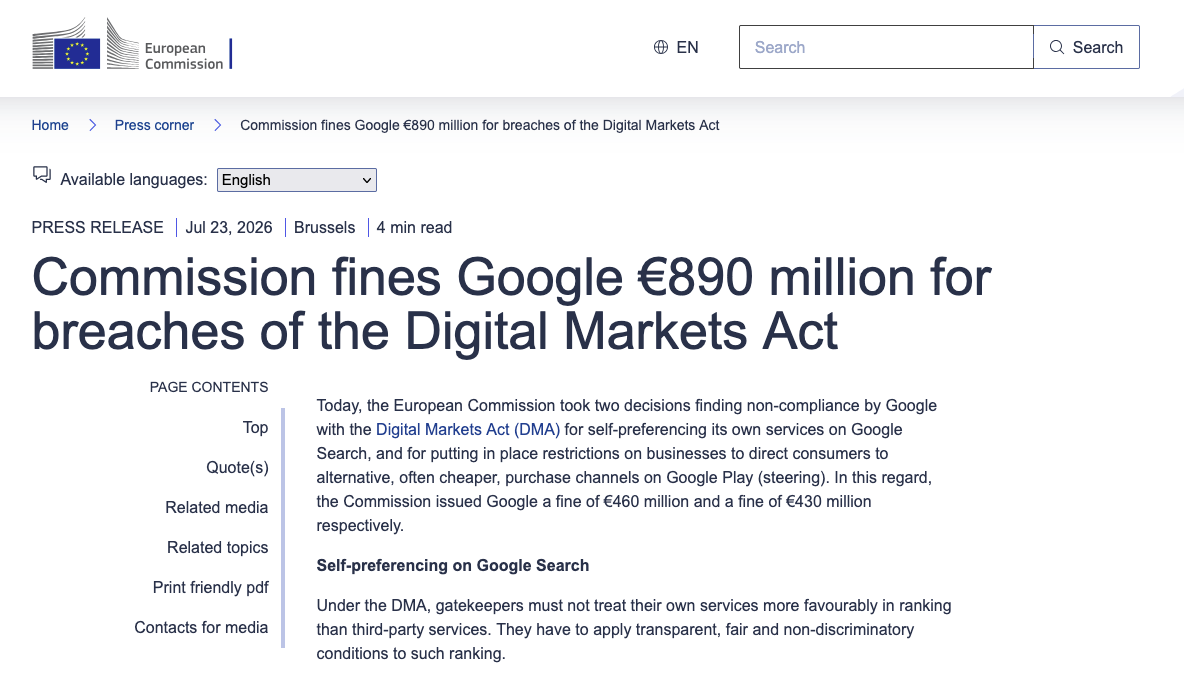
On 22 July 2026, the day before the Commission announced Google’s fine for not complaying with Article 6(5) of the DMA, we identified and documented a new hotel-results layout in Europe. The test continued to appear over the following days, allowing us to record its principal components and examine how it could change hotel discovery within the search engine results page.
The timing is significant, but it does not establish that the test was launched in response to the Commission’s final decision. Google has not confirmed that the layout constitutes its formal DMA remedy. Furthermore, Google had already described related proposals in November 2024, including expanded and similarly formatted units for comparison services and direct suppliers.
Nevertheless, the observed design provides an important indication of what a possible DMA-compliant hotel-search experience could look like. It also reveals the central question shaping the next stage of the debate: once Google reduces the preferential treatment of its own services, how should the resulting visibility be distributed among comparison services, OTAs and hotels’ official websites?

To our knowledge, we were the first agency to document and report this specific test. Barry Schwartz subsequently covered our findings in Search Engine Roundtable, quoting our initial analysis. If you are seeing the same or may be a different test, don’t hesitate to contact me directly.
All screenshots and videos documenting the test were captured by Neus de Pedro, our new colleague at Contenido SEO. Her work provided the visual evidence on which our initial analysis was based.
At the time of our first observation, the hospitality sector had not yet published its formal response. HOTREC has since welcomed the Commission’s enforcement action while warning that Google’s compliance measures must not replace one market distortion with another by favouring large intermediaries over hotels’ direct channels.
This analysis separates what we directly observed from what regulators and industry participants have confirmed—and from what can reasonably be inferred. It examines the test from an SEO and distribution perspective, evaluates the interests shaping the possible outcome and considers what hotels can do now to protect and strengthen their direct channels.
Our central proposition is that the success of the DMA remedy should not be judged solely by whether Google gives competing platforms more visibility. It should also be judged by whether consumers retain meaningful choice and whether hotels can compete directly for demand generated by their own properties and brands.
Part 2.
What we observed
We identified two previously unseen hotel-search elements appearing for generic queries such as “hotels in Playa de Palma”. The layout appeared consistently during testing on 23, 24 and 25 July 2026.
The modules appear to test a different way of distributing hotel visibility among Google, third-party travel platforms and hotels’ official websites.
Observation methodology
The test was recorded by Neus de Pedro on 23rd, 24th and 25th, 28th, 29th of July 2026 from a Windows laptop connected through Contenido SEO’s Spanish IP address.
Testing was conducted on desktop using Google Chrome, both while signed in to her Contenido SEO agency account and in Incognito mode. Searches were performed using Spanish/Spain and Dutch/Netherlands language and market configurations from a Spanish IP address.
The new modules appeared consistently throughout the three-day observation period of the first week, as well as during the second week.
Testing included the generic query “hotels in Playa de Palma” and several additional hotel searches such as: “hotel 4 estrellas en madrid centro”, “hotel boutique en el centro de barcelona”, “hotel para familias en mallorca”, “petfriendly hotel en playa de muro”, “adults only hotel mallorca”, amongst many others.
Screenshots and videos from the different sessions will be embedded in this analysis. These materials document the test as it appeared during the observation period; they should not be interpreted as evidence of a complete or permanent rollout across every EU market.
A) A new Hotel Local Pack
The “Hotel Multi-pack” module
The first element—referred to in this analysis as the Hotel Multi-Pack—presents several third-party travel platforms within the search results.
Each provider can be expanded to reveal its own selection of hotels, effectively creating a platform-specific hotel-discovery experience inside Google’s results.
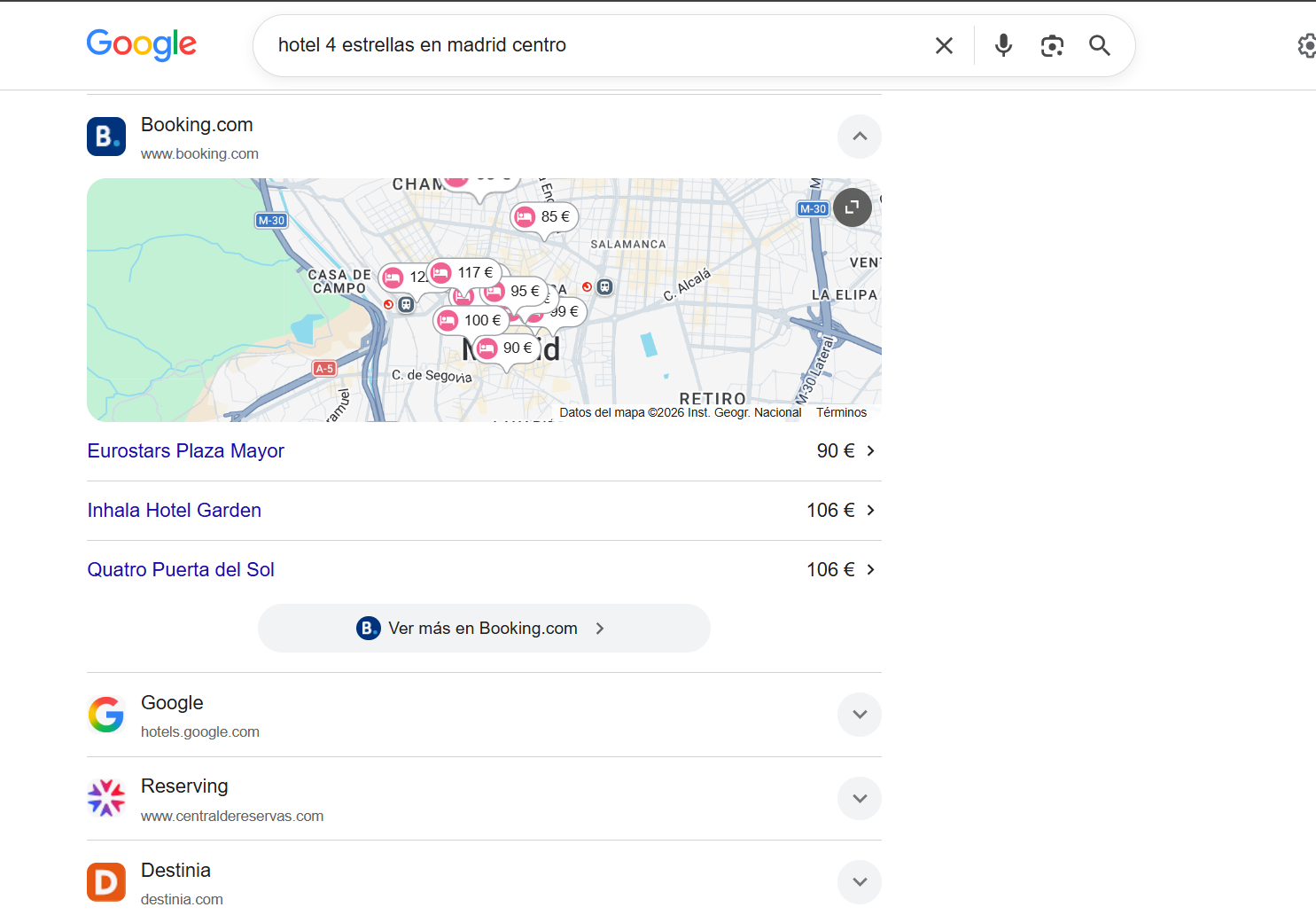
The first element—referred to in this analysis as the Hotel Multi-Pack—presents several third-party travel platforms within the search results.
Each provider can be expanded to reveal its own selection of hotels, effectively creating a platform-specific hotel-discovery experience inside Google’s results.
This introduces an additional decision before the traveller selects a property. Rather than moving directly from a destination search to an individual hotel, the user may first choose the intermediary or comparison platform through which to explore the destination.
If this becomes part of Google’s final design, OTAs and comparison services could gain influence at an earlier point in the customer journey. The module could therefore affect not only which hotels receive visibility, but also which platforms control the comparison process and the subsequent route towards booking.
B) A New module for hotels direct website
The “Hotel Website sites” module
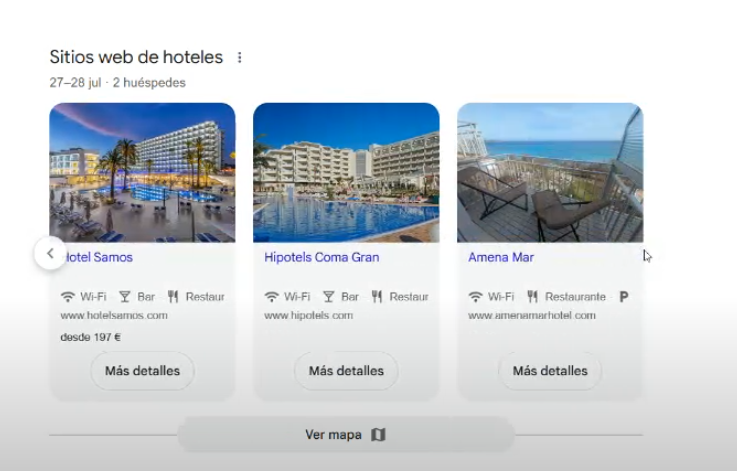
The second element is a dedicated “Hotel websites” module featuring hotel cards with prices and links to official websites. This could create valuable visibility for direct suppliers by presenting official hotel websites as a distinct category within the results. Its actual value, however, cannot be determined from its existence alone.
The effect on the direct channel will depend on:
- Where the module appears relative to ads, intermediary results and other hotel features.
- Which hotels are eligible to participate.
- How Google identifies and verifies an official website.
- How rates and availability are sourced.
- Whether the displayed direct price is competitive and accurate.
- How much information each hotel can present.
- Whether users recognise the module as a direct-booking option.
- How frequently travellers click through and complete a direct booking.
- Can hotels measure this traffic.
The module is therefore potentially positive for hotels, but visibility does not automatically produce traffic or revenue. Its impact will depend on presentation, placement, eligibility, data quality, price competitiveness and user behaviour.
Why the combination matters
The two modules should not be assessed independently.
The Hotel Multi-Pack could direct travellers into an intermediary environment before they have selected a property. The Hotel websites module could provide official websites with a new direct surface, but possibly later in the journey or lower on the results page.
The decisive question is therefore not simply whether both types of participant appear. It is whether their placement, functionality and presentation give consumers a genuine choice between intermediaries and direct suppliers.
How the test differs from the established experience
| Area | Established hotel-search experience | Observed test |
| Initial discovery | Google’s hotel and local-search features play the central role | Third-party travel platforms receive a dedicated discovery module |
| First user choice | The traveller commonly evaluates properties first | The traveller may select a platform before selecting a property |
| Official websites | Visible through organic, local, Hotel Ads and Free Booking Link surfaces | Presented through a dedicated Hotel websites module |
| Intermediary role | OTAs compete within Google’s existing hotel ecosystem | Platforms may operate expandable hotel selections within the SERP |
| Google’s position | Controls the hotel-search interface and associated features | Continues controlling the interface while redistributing visibility within it |
This comparison remains provisional. Google has not confirmed that the observed layout will become permanent, and the design may change during testing.
Part 3.
How we got here
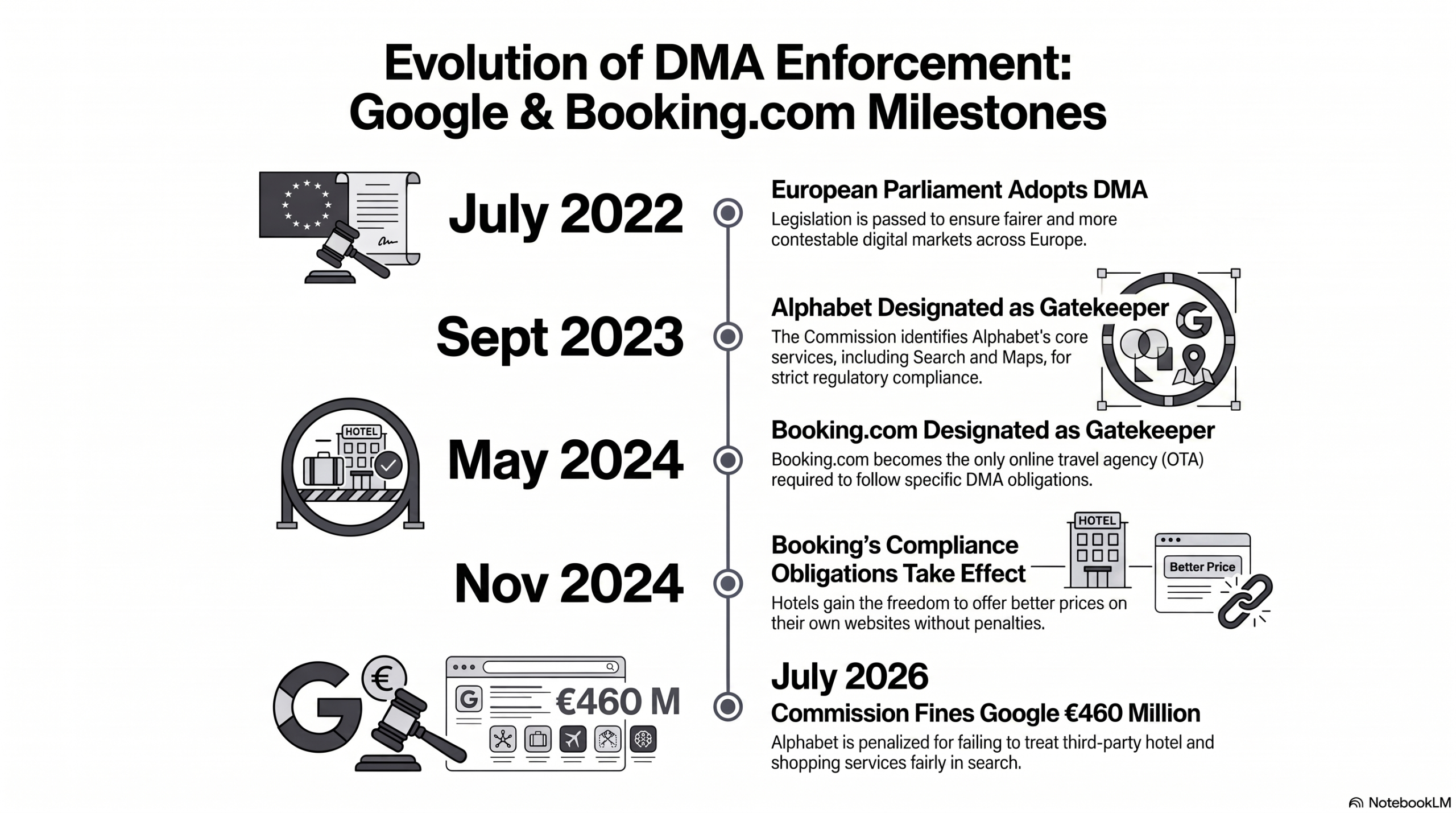
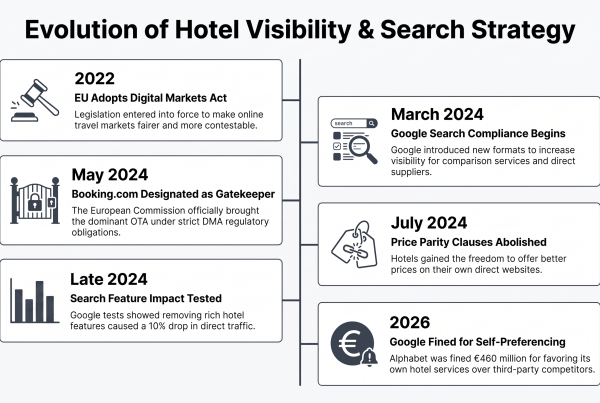
Readers looking for the complete regulatory background can consult our interactive Digital Markets Act timeline. It follows the process from the DMA’s adoption and Alphabet’s gatekeeper designation through the proceedings involving Google and Booking.com, explaining what each development means for hotels and their direct distribution strategies. This article focuses more narrowly on the hotel-search test and the competing interests that could shape Google’s eventual remedy.
The Commission is making that assessment under considerable external pressure. Google has published its criticism of recent DMA decisions in several European markets, arguing that the measures threaten privacy, security and the quality of its products; Apple has similarly portrayed the DMA as harmful to innovation and the European user experience. The Trump administration has reinforced that corporate opposition at a political and trade level: following the latest Google decision, the US Trade Representative accused the EU of targeting successful American technology companies and warned of consequences for transatlantic relations. This pressure is documented; whether it has influenced the Commission’s decisions cannot be established from the public record. What is clear is that some of the world’s most powerful and profitable corporations are resisting rules intended to limit the advantages created by their control of essential digital markets. Their objections deserve examination—but so do the interests of the businesses and citizens expected to share fairly in the value those markets create.
Part 4.
Digital Markets Act (DMA) · The Law
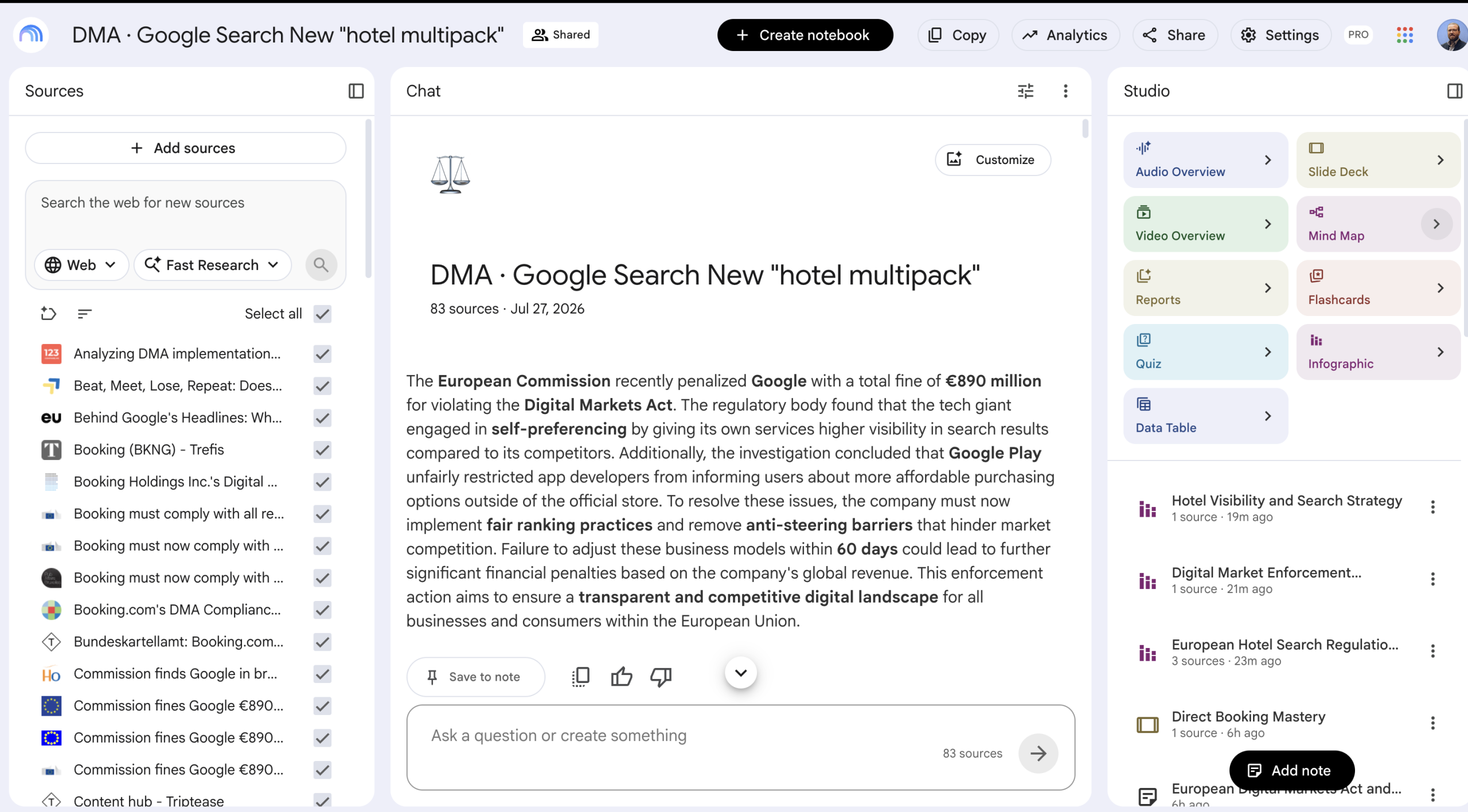
To make this complex topic easier to explore, I’ve created a NotebookLM containing the DMA legislation, regulatory decisions, industry statements and articles used in my research. You can use it to ask questions, compare different perspectives and trace claims back to their original sources. I’m a strong supporter of NotebookLM—it’s an incredibly useful tool for making sense of a large and sometimes overwhelming collection of information.
What Article 6(5) means for this analysis
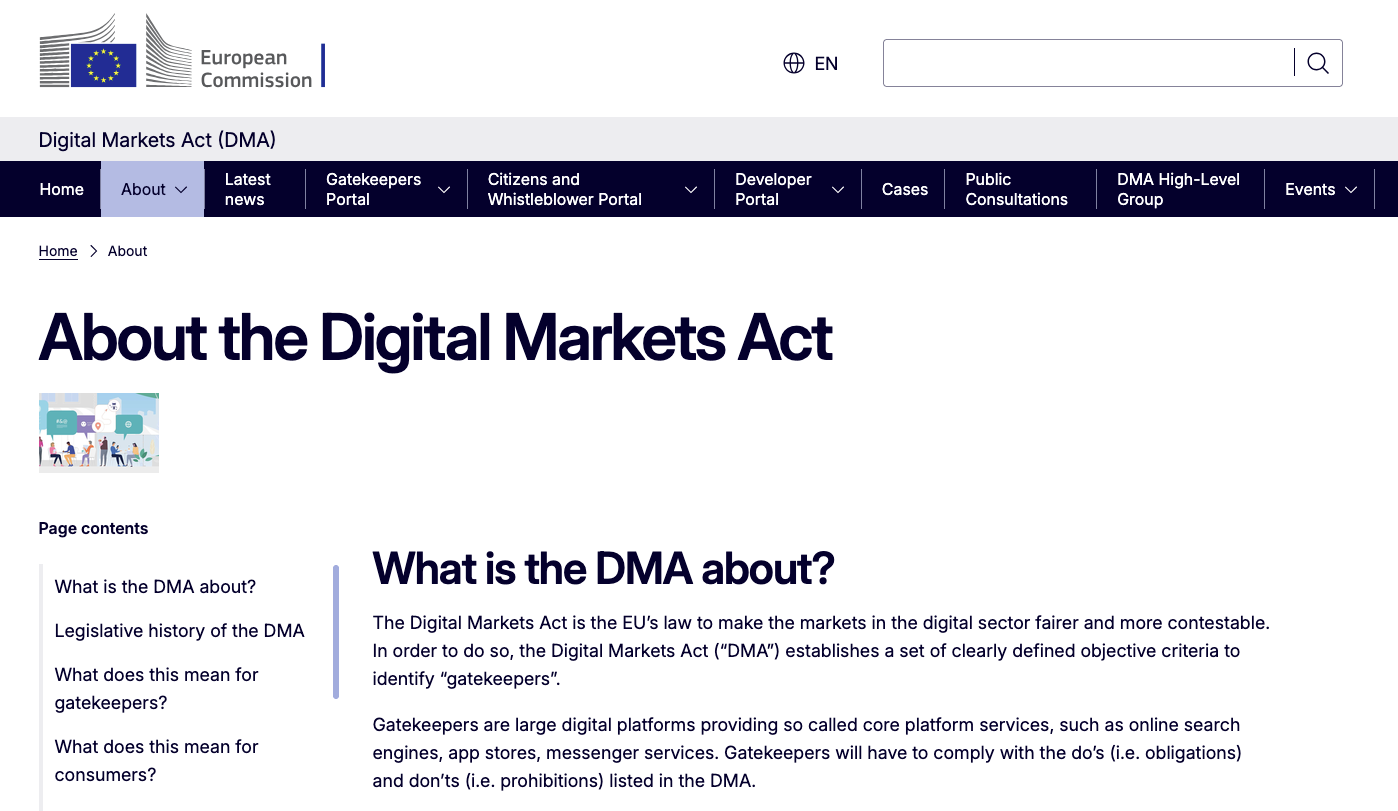
Article 6(5) requires a gatekeeper not to treat its own services and products more favourably in ranking—and related indexing and crawling—than similar services or products offered by third parties. The conditions applied must be transparent, fair and non-discriminatory.
Its immediate legal purpose is therefore to prevent Google from favouring its own services over comparable third-party services.
It does not automatically determine:
- Whether an official hotel website must appear before an OTA.
- What share of visibility direct suppliers should receive.
- Where a particular module must appear.
- Whether a consumer should encounter a hotel or an intermediary first.
- How visibility should be divided among different categories of third parties.
These are precisely the questions now emerging from implementation.
HOTREC’s demand for meaningful direct-supplier visibility is consistent with the DMA’s broader objectives of fairness and contestability. It should nevertheless be presented as a policy and market-design position—not as an outcome already expressly guaranteed by Article 6(5).
The history therefore matters because the remedy must address Google’s self-preferencing without ignoring the concentration already present in hotel distribution. A solution that reduces Google’s preferential treatment but significantly increases hotels’ dependence on another powerful intermediary may satisfy part of the legal problem while leaving the wider competition problem unresolved.
Part 5.
The positions shaping what happens next

Eu travel tech is a Brussels-based trade association representing the interests of travel-technology and distribution companies. Its membership includes OTAs, metasearch services, global distribution systems, travel-management companies and other travel platforms.
Its published members include Booking.com, Expedia Group, Airbnb, Amadeus, Etraveli Group, eDreams ODIGEO, Skyscanner, Tripadvisor and Travelport, among others.
Position 1
eu Travel Tech—greater visibility for competing travel platforms
Eu travel tech is a Brussels-based trade association representing the interests of travel-technology and distribution companies. Its membership includes OTAs, metasearch services, global distribution systems, travel-management companies and other travel platforms.
Its published members include Booking.com, Expedia Group, Airbnb, Amadeus, Etraveli Group, eDreams ODIGEO, Skyscanner, Tripadvisor and Travelport, among others.
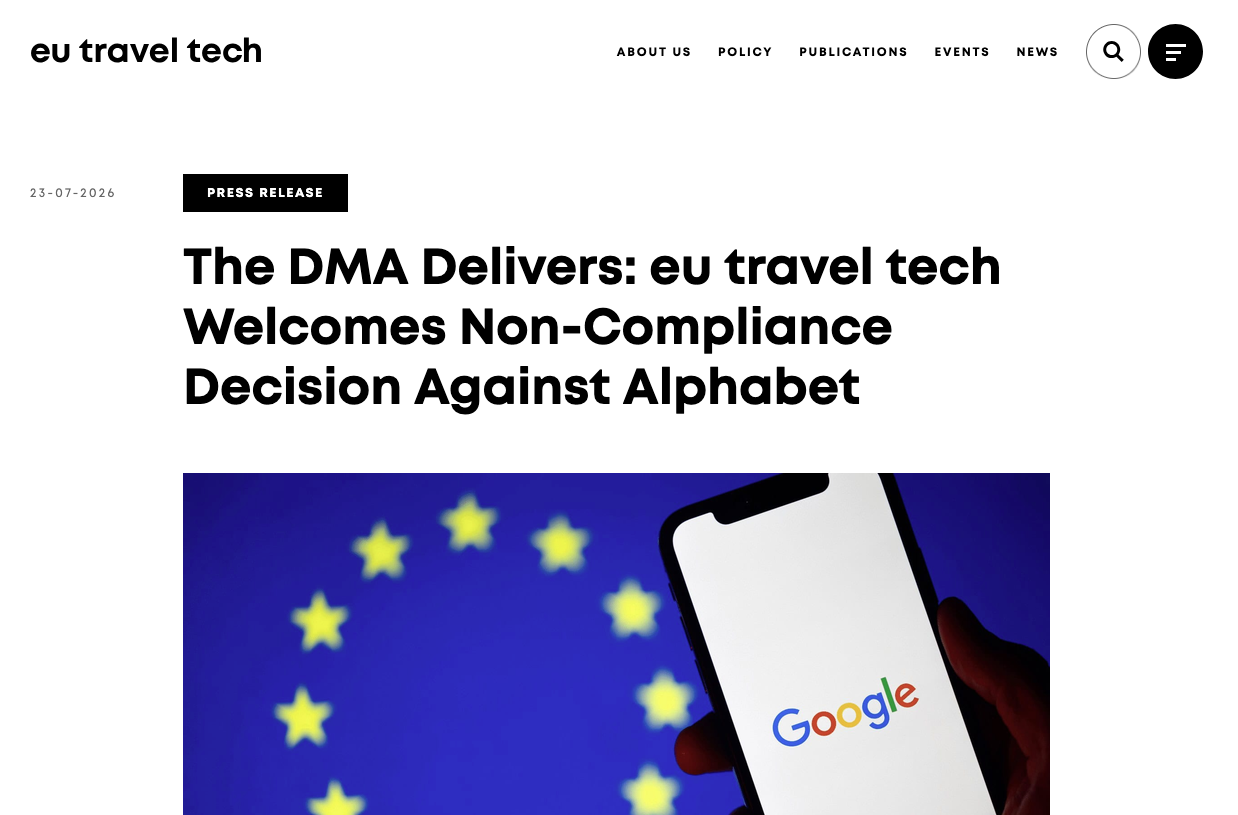
The lobby welcomed the Commission’s decision. It argues that Google has historically presented its own travel services in a more attractive, interactive and prominent form than competing specialist services, limiting competition and consumer choice.
Its position is that Google must end self-preferencing across paid and organic Search, including within AI Overviews and AI Mode. It is also concerned that Google’s latest proposals may still fall short of full compliance.
This is an important and legitimate part of the regulatory debate. Google should not be able to use its control of Search to give its own hotel and travel services an advantage unavailable to competing services.
If the observed Hotel Multi-Pack becomes part of Google’s final solution, it appears to provide the type of additional third-party platform visibility that eu travel tech has requested. However, this similarity does not establish that the association caused or directly shaped the test.
Eu travel tech’s position should also be understood as a stakeholder position advanced on behalf of travel-technology and distribution companies. It is not intended to represent the interests of hotels’ direct channels.
Those interests may align when challenging Google’s self-preferencing. They may diverge when the question becomes how the resulting visibility should be distributed among OTAs, comparison services and hotels’ official websites.
Booking.com’s role makes this distinction particularly important. It is both a member of eu travel tech and the only OTA currently designated as a gatekeeper under the DMA. HOTREC has separately asked the Commission to investigate whether Booking.com is complying fully with its obligations to hotels.
This does not invalidate eu travel tech’s criticism of Google. It does mean that transferring substantial visibility to powerful intermediaries cannot automatically be treated as equivalent to creating a fairer and more contestable hotel-distribution market.
The relevant test is not whether Google’s competitors receive more visibility in isolation. It is whether the resulting design creates meaningful competition among Google, intermediary platforms and direct suppliers.
Position 2
HOTREC, do not replace one market distortion with another
HOTREC represents hotels, restaurants, cafés and national hospitality associations across Europe. Its position is therefore the most directly aligned with the interests of hospitality businesses and their direct channels.
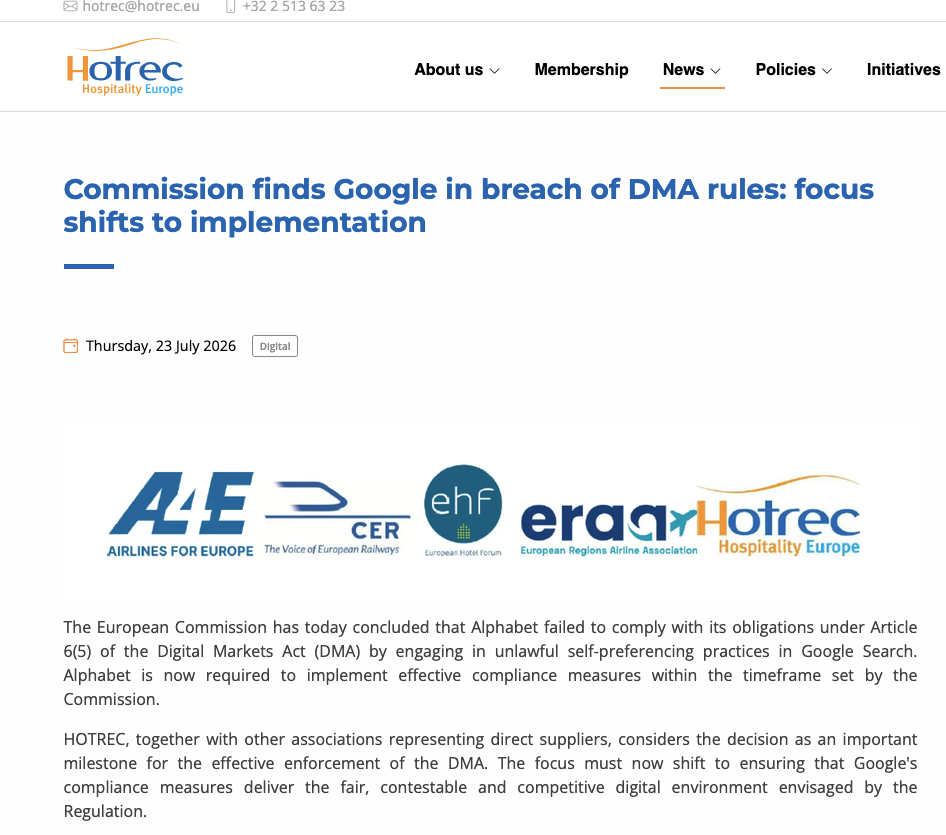
HOTREC welcomed the Commission’s enforcement action against Google, describing it as an important step towards the fairer and more contestable digital environment envisaged by the DMA.
However, it issued an important warning: Google’s compliance measures should not correct its own self-preferencing by creating a new advantage for OTAs and comparison services at the expense of direct suppliers.
HOTREC is concerned that some of the solutions under discussion could reduce the visibility of hotels’ official websites, limit consumer choice and reinforce hospitality businesses’ dependence on intermediary platforms.
It argues that implementation should:
- Preserve price transparency and the accuracy of information shown to consumers.
- Guarantee fair and non-discriminatory visibility for all eligible market participants, including direct suppliers.
- Maintain meaningful consumer choice between official websites and intermediaries.
- Support an open digital ecosystem that encourages competition, investment and innovation.
This position is particularly relevant because hotels invest in their own websites, booking technology, content, customer relationships and direct-booking offers. A remedy that gives additional visibility to intermediaries while making official websites harder to find could increase distribution costs without materially improving competition.
HOTREC’s position should nevertheless be understood as an industry-advocacy position. Article 6(5) directly prohibits Google from favouring its own services over similar third-party services. It does not expressly prescribe a particular position or share of visibility for hotels’ official websites.
HOTREC is therefore making a broader policy argument: a formally compliant interface should also advance the DMA’s objectives of fairness, contestability and consumer choice.
The organisation has separately argued that Booking.com remains non-compliant with its DMA obligations. In November 2024, it asked the Commission to open formal non-compliance proceedings, citing concerns including ranking transparency, business-user data and Booking.com’s payment practices.
These remain HOTREC’s allegations and should not be presented as findings already reached by the Commission.
Taken together, HOTREC’s positions on Google and Booking.com reveal the wider structural issue. Hotels can be commercially dependent on both Search and online intermediaries. Reducing the power exercised through one part of that distribution system will not necessarily create a fairer market if influence simply moves to another powerful platform.
The test for the final remedy should therefore be whether hotels can reach consumers directly under fair conditions—not merely whether Google displays more third-party intermediaries.
Position 3
Google, comply while preserving the search and discovery experience
Google’s position should be assessed through both its public statements and the commercial incentives associated with its role in hotel discovery.
The company argues that the DMA has required substantial changes to European Search, including more than 20 modifications intended to increase the prominence of comparison services in categories such as hotels, flights and shopping.
Google maintains that some of these changes have benefited large aggregators and comparison services while making it more difficult for airlines, hotels and other direct suppliers to reach consumers.
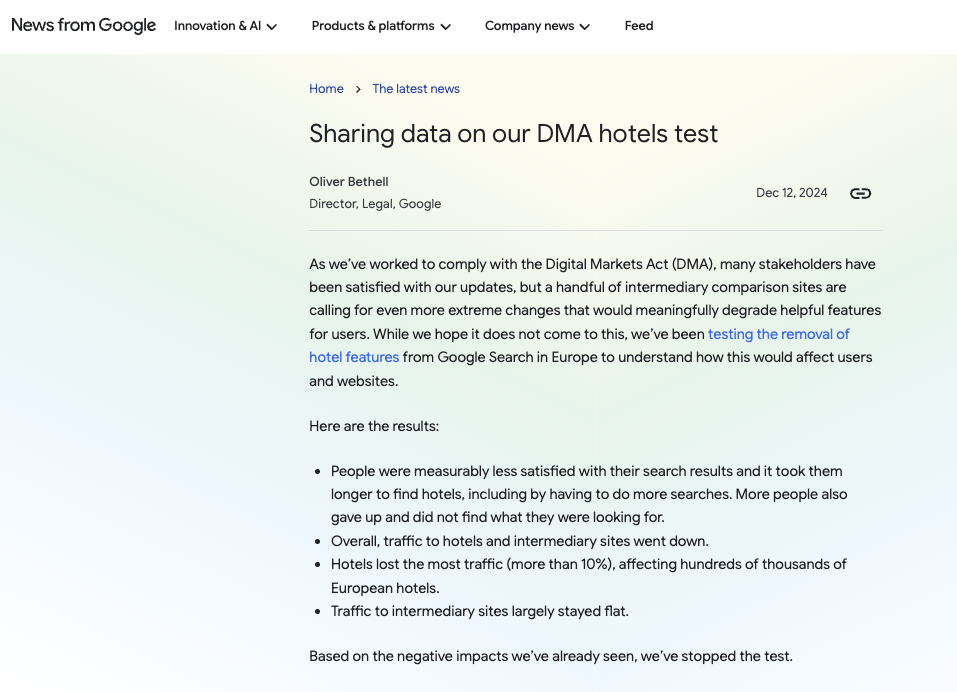
In November 2024, Google described several proposed formats designed to balance these competing interests. They included:
- Expanded and similarly formatted units allowing users to choose between comparison services and direct suppliers.
- Formats through which websites could display richer information, including prices and images.
- New advertising units for comparison services.
Google also tested removing hotel maps and other rich hotel-search features in Germany, Belgium and Estonia.
The company subsequently reported that hotels lost more than 10% of their traffic during the experiment, traffic to intermediary sites remained broadly flat and users were less satisfied with the results. Google then ended the test.
These findings are relevant, but they were published by Google without an independently available dataset or external audit. They should be treated as evidence of Google’s position—not as a neutral or complete measurement of the market effect.
Google’s stated objective is to comply with the DMA while preserving useful search functionality for consumers and businesses. It argues that reducing hotel results to conventional links would degrade the user experience and make it harder to find relevant information.
The layout observed in July 2026 appears broadly consistent with that strategy. Rather than removing the hotel-discovery experience, it retains a rich Google-controlled interface while giving comparison services and official hotel websites separate forms of visibility.
Google has not confirmed that the test is part of its formal compliance proposal. The similarity between the observed layout and its earlier public proposals is nevertheless significant.
Google’s commercial incentives
We cannot determine Google’s intentions from an interface test alone. We can, however, examine the incentives created by its position in the market.
Google benefits from remaining the principal interface through which travellers discover, compare and evaluate hotels. Retaining that role allows it to:
- Continue serving advertising throughout the discovery journey.
- Collect interaction signals that can improve its search and advertising products.
- Influence how users move from a query to a property or booking provider.
- Preserve Google Search as the starting point for hotel research.
- Avoid a user experience in which travellers move immediately to another platform.
Large OTAs aggregate substantial inventories, operate across many markets and invest heavily in Google’s advertising products. Individual hotels and smaller groups typically operate with less inventory, smaller budgets and more geographically concentrated demand.
This does not prove that Google designed the observed module to favour OTAs because they are major advertisers. Organic product design and advertising expenditure should not be treated as causally connected without evidence.
It does, however, explain why any solution that gives powerful intermediaries greater prominence while increasing hotels’ dependence on paid visibility deserves careful examination.
The Hotel Multi-Pack could allow Google to increase third-party visibility while continuing to control the interface and the wider discovery process. From Google’s perspective, this may offer a compromise between removing its hotel functionality and maintaining the existing presentation of its own specialist services.
This interpretation remains an inference. It should be tested against the final design and its measurable effects rather than presented as confirmed intent.
The central tension in Google’s position
Google may be correct that rich hotel-search features are useful to consumers and direct suppliers. It may also have a commercial interest in maintaining control of those features.
Both statements can be true.
The relevant question is not whether Google should be prohibited from creating a useful hotel-search experience. It is whether Google can maintain that experience without unfairly favouring its own services or designing the remedy in a way that disproportionately strengthens another group of powerful intermediaries.
Position 4
The European Commission: the remedy will determine whether enforcement succeeds
The European Commission’s formal position is that Google must end the preferential treatment of its own services and apply transparent, fair and non-discriminatory conditions to ranking in Search.
Its 23 July decision requires Google to end the infringement within 60 days. Failure to comply could expose the company to periodic penalty payments of up to 5% of its total worldwide turnover.
The fine establishes that Google’s previous implementation was insufficient. It does not, by itself, determine what the final hotel-search interface must look like.
That question will now be addressed through implementation.
If the interface we observed forms part of Google’s proposed remedy, the Commission will need to determine whether giving comparison services and official hotel websites separate search modules satisfies Article 6(5).
The Commission’s assessment will send an important signal beyond the travel sector. It will indicate whether compliance can be achieved by redistributing visibility within a gatekeeper-controlled interface—and which competitive outcomes the Commission considers acceptable.
The Commission’s immediate legal test
The immediate legal question is whether Google has ended the more favourable treatment of its own services relative to similar third-party services.
This is narrower than asking whether every participant in hotel distribution receives an equal share of visibility. The DMA does not automatically prescribe identical placement for Google, comparison services, OTAs and individual hotel websites.
Nevertheless, the Commission must consider whether Google’s remedy is effective in practice. A formally different interface would not constitute meaningful compliance if its design, ranking rules or functionality continued to favour Google’s own services.
The Commission will therefore need to examine:
- Which services qualify for each module.
- Whether the eligibility rules are objective and transparent.
- Whether Google’s own services retain functional or presentational advantages.
- How ranking operates within each module.
- Whether paid and organic visibility are clearly distinguished.
- Whether AI Overviews and AI Mode reproduce the same self-preferencing concerns.
- Whether the Commission and affected businesses receive sufficient data to evaluate the outcome.
The wider market test
The Commission’s legal assessment should also be considered against the DMA’s broader objectives of fairness and contestability.
A remedy may reduce Google’s self-preferencing while still concentrating additional visibility among a small number of powerful intermediaries. That would not necessarily mean that Google remained in breach of Article 6(5), but it would raise a wider question about whether the market had become meaningfully more contestable.
The relevant issue is not primarily whether the intermediary benefiting from the change is European or American. It is whether the remedy:
- Expands meaningful consumer choice.
- Gives new and smaller participants a realistic opportunity to compete.
- Preserves a viable route from Search to direct suppliers.
- Reduces dependence on gatekeepers rather than moving that dependence elsewhere.
- Improves price and provider transparency.
- Avoids creating a new mandatory intermediary layer.
- Produces outcomes that can be independently measured.
This distinction is particularly important in hotel distribution, where one of the largest potential beneficiaries—Booking.com—is itself a DMA-designated gatekeeper.
The Commission should apply its principles consistently. Its assessment of Google’s Search remedy and its monitoring of Booking.com concern different designated services and legal obligations, but both processes affect whether hotels can compete and reach consumers on fair terms.
Enforcement under external political pressure
The decision was issued amid significant political and trade pressure from the United States.
The US Trade Representative criticised the Commission’s action, arguing that EU enforcement was disproportionately targeting American technology companies and creating uncertainty in the transatlantic trading relationship.
Following the decision, President Trump announced that the United States would pursue a Section 301 investigation into European practices affecting US technology companies and threatened retaliatory tariffs.
This context demonstrates the political pressure surrounding DMA enforcement. It does not establish that external pressure influenced the design of the hotel-search remedy.
The political issue should therefore remain secondary to the competition analysis. The decisive question is whether the Commission evaluates Google’s implementation according to the evidence, the legal requirements and the observable effects on businesses and consumers.
How the remedy should be judged
The existence of additional third-party modules will not, by itself, demonstrate successful compliance.
The Commission should assess:
- Whether Google’s own services have lost their previous advantages.
- Whether direct suppliers and competing platforms are admitted under transparent rules.
- Whether consumers can identify the official hotel website.
- Whether equivalent information and functionality are available where services are comparable.
- Whether the interface preserves genuine provider choice.
- Whether visibility becomes concentrated among the largest intermediaries.
- Whether hotels face greater pressure to repurchase access to their own branded demand through advertising.
- Whether the same principles extend into AI-assisted Search.
- Whether Google provides adequate impression, click and ranking data for independent assessment.
The Commission’s enforcement will ultimately be judged not only by the fine, but by the competitive conditions produced by the remedy.
For hotels, the critical outcome is whether the new Search environment preserves a meaningful and commercially viable path to the direct channel.
Part 6.
Follow the money: advertising scale shapes hotel visibility
The commercial relationship between Google and the major OTAs is central to understanding the economics surrounding hotel-search visibility.
Large intermediaries invest billions of dollars annually in acquiring traffic. That expenditure does not prove that Google designs organic results to favour those companies. It does demonstrate that OTAs can compete for visibility at a scale beyond the reach of most independent hotels and hotel groups.
I’ve broken down exactly how much the major OTAs spend on search marketing — and what that scale means for a hotel’s direct channel — in a dedicated analysis: Follow the money: advertising scale shapes hotel visibility.

Part 7.
AI search will extend the same competition questions into a new interface
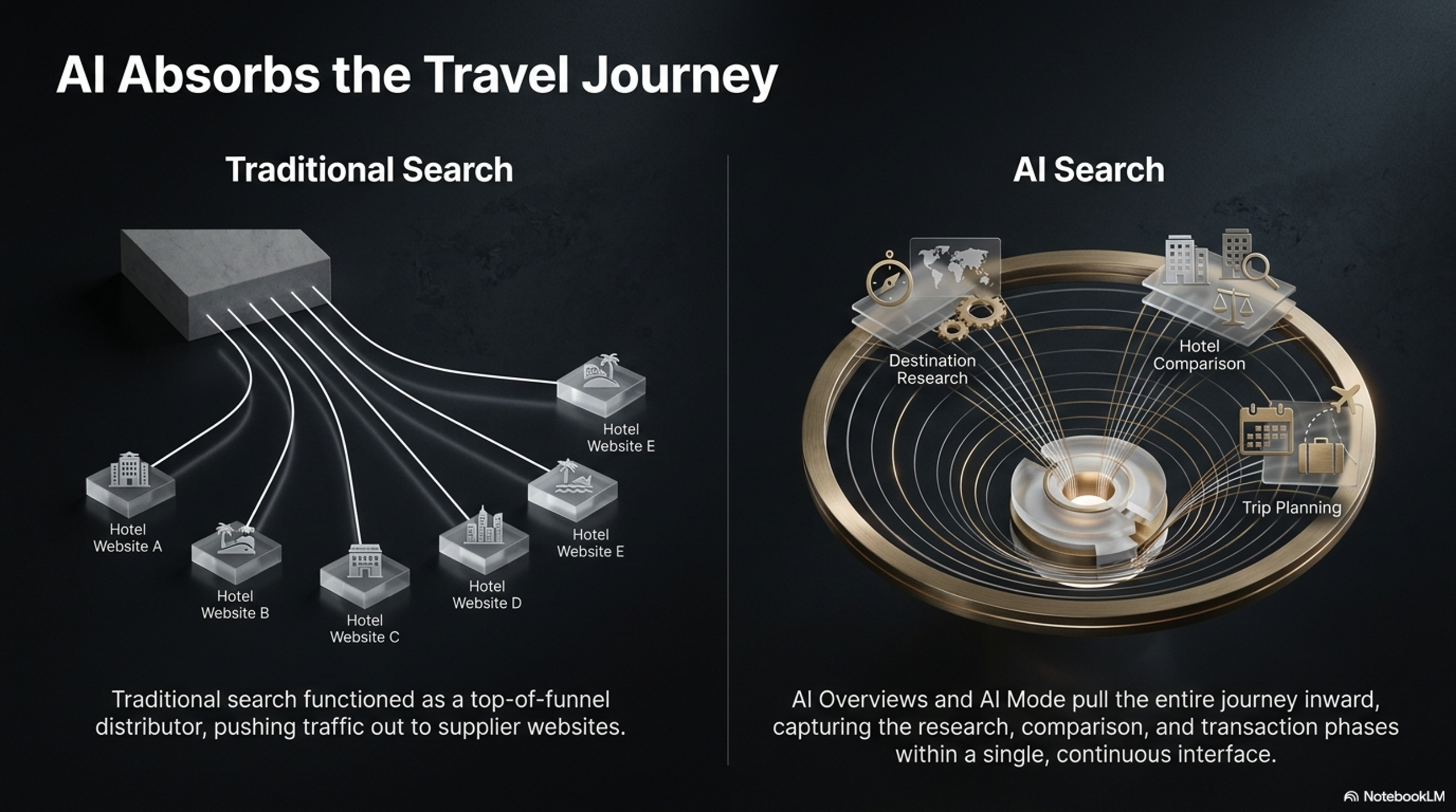
Takeaway: As AI Overviews and AI Mode absorb more of the travel journey, the DMA’s self-preferencing questions move with them — from “where does a site rank?” to “which sources does the AI select, trust and cite?”
AI Overviews and AI Mode are becoming increasingly integrated into Google Search. As travellers use these interfaces to research destinations, compare hotels and plan trips, the questions surrounding ranking and self-preferencing will extend beyond conventional search results.
EU Travel Tech argues that AI Overviews and AI Mode fall within DMA Article 6(5), because they are embedded in Google Search and can present Google’s own travel information alongside — or instead of — third-party sources.
That interpretation is relevant, but it is one party’s position, not the final legal resolution of every AI-search question. The Commission will still need to assess how Article 6(5) applies to specific AI-generated experiences, and whether those experiences reproduce the advantages already identified in conventional Search.
How AI search changes the unit of visibility
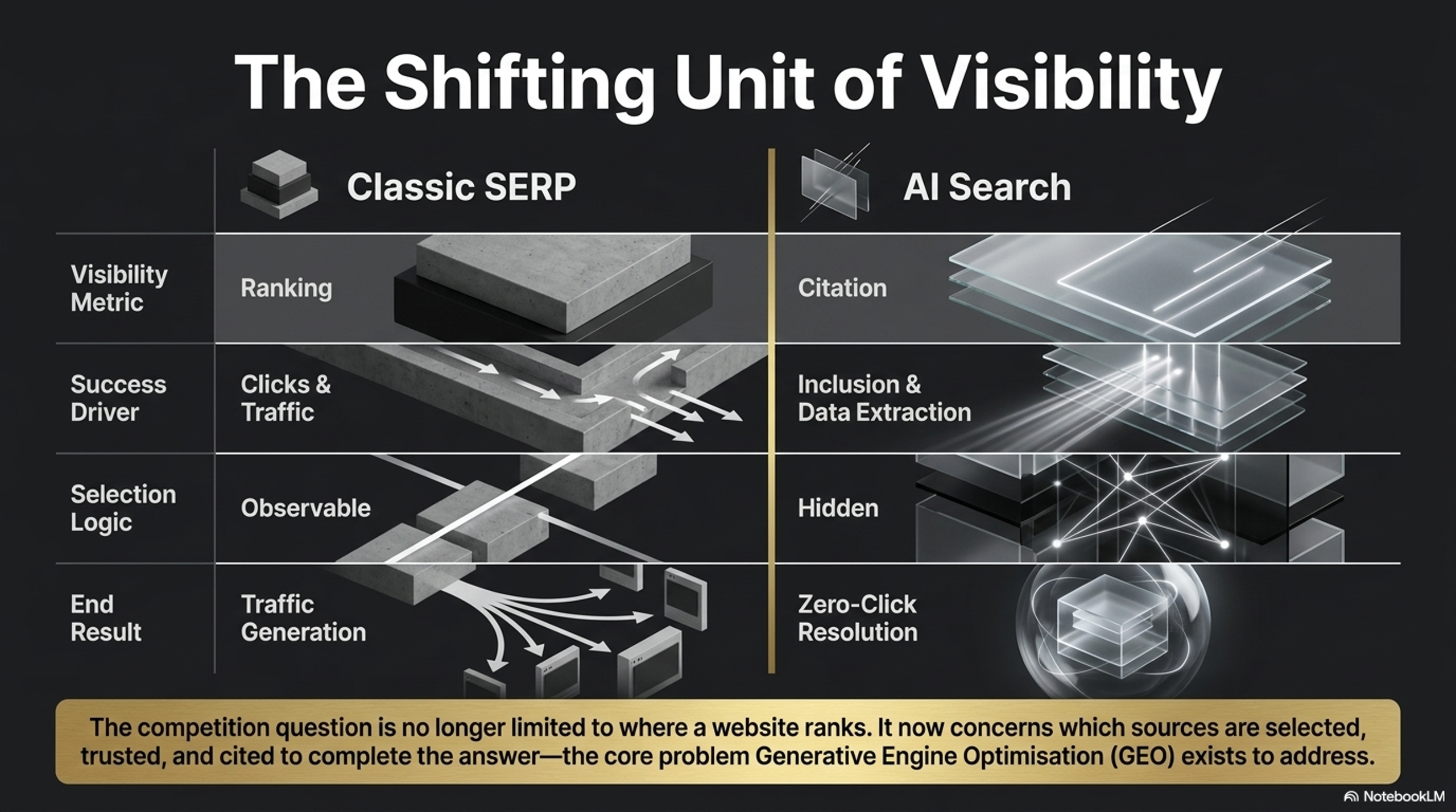
Takeaway: In a classic SERP, visibility is a ranking. In an AI answer, visibility is a citation — and the selection logic behind it is far less observable.
In a conventional SERP, visibility can usually be evaluated through rankings, modules, links and impressions. In an AI-generated answer, the selection process is largely hidden. The system can:
- Choose which properties to mention.
- Decide which sources inform the recommendation.
- Summarise hotel information without ever generating a visit.
- Select which prices or providers to display.
- Recommend an OTA, a comparison service or the official website.
- Retain the traveller inside the Google interface for more of the journey.
- Influence the eventual booking without producing a conventionally attributable click.
The competition question is therefore no longer limited to where a website ranks. It now concerns which sources are selected, trusted, cited and used to complete the answer — the core problem that Generative Engine Optimisation (GEO) exists to address.
The direct channel must remain an eligible source and booking option
Takeaway: Stopping Google from favouring its own travel services is necessary but not sufficient. The official website also has to remain an eligible source and a selectable booking option inside the AI answer.
Preventing Google from favouring its own travel services protects competitors. It does not, on its own, protect a hotel’s direct channel. For that, the hotel’s official website has to be eligible to participate as an authoritative source of:
- Property identity and ownership.
- Room types and amenities.
- Rates and availability.
- Policies and direct-booking conditions.
- Images and descriptive content.
- Location and destination information.
- Exclusive direct benefits.
- Accessibility and sustainability information.
Where an AI system recommends a hotel or presents booking options, the official website should remain a visible, meaningful choice whenever it can supply the relevant rate and availability. This does not mean preventing travellers from using OTAs. It means the direct supplier is not excluded from the comparison, or reduced to just another distributor of its own inventory.
Why the booking-provider decision becomes critical
Takeaway: Once AI journeys move from research to transaction, the AI’s choice of booking provider decides who owns the guest, the data and the margin — not just who ranks.
As AI-assisted journeys progress from research and comparison toward the transaction itself, a set of commercial questions becomes decisive:
- Which booking provider does the AI select, and on what basis?
- Was the official website considered at all?
- Is provider selection driven by relevance, price, commercial participation or something else?
- Are sponsored and organic recommendations clearly distinguished?
- Can the traveller choose a different provider before booking?
- Are direct rates and benefits compared accurately against OTA offers?
- Can a hotel correct inaccurate information before it shapes a recommendation?
- Who owns the customer relationship and the booking data?
- Which party processes payment, amendments and cancellations?
- Can the hotel measure the bookings its AI presence influenced or completed?
These questions reach well beyond SEO. They concern distribution control, customer ownership, commercial terms, and a hotel’s ability to participate in emerging booking channels at all.
What transparency and control hotels actually need
Takeaway: Hotels don’t need to see the model’s internals — they need answer-level accountability: which sources were used, whether direct was eligible, and what the AI presence produced.
Hotels should receive enough information to understand how their properties are represented within AI-powered Search. At minimum, that includes:
- Which hotel-controlled and third-party sources were used.
- Whether the official website was eligible for consideration.
- Which booking providers were displayed or selected.
- Whether an intermediary’s visibility was organic or paid.
- Which rates, offers and conditions were compared.
- Whether OTA-funded discounts influenced provider selection.
- How many impressions, referrals and bookings the AI experience generated.
- How inaccurate property or rate information can be corrected.
Some of this is genuinely hard to expose at the level of an individual answer. That technical difficulty is a reason to design proportionate reporting — not a justification for complete opacity.
Hotels cannot realistically control every channel
Takeaway: “Let hotels approve every platform” sounds right but breaks against wholesale, affiliates and competition law. The defensible goal is visibility, correction and enforcement — not total control.
The idea that a hotel should decide which platforms may represent or advertise its property is commercially attractive, but it needs qualification. Contracts, wholesale inventory, affiliates, resellers and competition rules can all make complete channel control impossible. A hotel may not even know every downstream distributor displaying its inventory, let alone authorise each one.
A more defensible objective is that hotels should be able to:
- Identify the providers representing their property.
- Understand the source of the inventory and rate displayed.
- Correct inaccurate or unauthorised information.
- Enforce applicable contractual distribution conditions.
- Control the direct feeds and channels they activate.
- Access meaningful performance data.
- Compete through the official website on transparent terms.
This preserves the principle of commercial autonomy without promising a level of control that is neither technically nor contractually achievable.
The DMA remedy must be evaluated across Search and AI
Takeaway: A fix that only touches conventional modules fails if the same preference reappears inside AI answers. The remedy has to hold in both surfaces.
A remedy confined to conventional modules could be quietly undone if the same preferential treatment re-emerges inside AI-generated results. The Commission should therefore examine whether:
- AI-generated recommendations apply fair source-selection criteria.
- Google’s own travel services receive preferential access or presentation.
- Official hotel websites can participate as both sources and booking providers.
- Competing services receive fair treatment where their offerings are comparable.
- Advertising and commercial relationships are disclosed clearly.
- Businesses receive enough information to measure material changes in visibility and traffic.
The interface observed in July 2026 should not be treated as the final model. The longer-term test is whether both conventional and AI-powered Search preserve a meaningful, competitive route between the traveller and the direct supplier.
Part 8.
What happens next: the 60-day implementation period
Google has 60 days to bring the infringements identified by the Commission to an end.
Failure to implement an effective remedy could lead to periodic penalty payments under the DMA. These can reach up to 5% of the company’s average daily worldwide turnover for each day of delay, subject to the Commission’s formal enforcement process.
The €460 million Search fine therefore does not conclude the case. It begins the most consequential stage for hotels: the design, implementation and evaluation of Google’s remedy.
The observed test may not be the final solution
Google has not confirmed that the hotel-search layout documented on 23, 24 and 25 July forms part of its formal compliance proposal.
Several outcomes remain possible:
- The test could be expanded to more users and EU markets.
- Its design, module order or eligibility criteria could change.
- Google could combine elements of the test with other proposed formats.
- The interface could be abandoned if performance or regulatory feedback is negative.
- Different layouts could be used for different query types or markets.
- The Commission could conclude that the proposed remedy remains insufficient.
- Google could challenge parts of the decision or subsequent enforcement through the courts.
The current interface should therefore be treated as evidence of a possible direction—not as the final European hotel-search model.
Google is testing redistribution rather than removal
The layout appears to take a different approach from Google’s 2024 removal experiment.
That earlier test replaced rich hotel-search features with more conventional links. Google reported that the result reduced user satisfaction and caused hotels to lose more than 10% of their traffic.
The July 2026 design retains rich hotel-search functionality but divides it into separate surfaces for third-party travel platforms and official hotel websites.
This suggests a shift from testing whether rich hotel features should remain to testing how visibility within those features should be distributed.
That is an important development. The debate is no longer simply about whether Google should reduce the prominence of its own hotel service. It is about:
- Which participants receive the released visibility.
- Where each participant appears.
- What functionality each participant receives.
- Whether direct suppliers remain competitive.
- Whether the user encounters a hotel or an intermediary first.
- Whether Google continues to control the overall discovery journey.
Three plausible implementation scenarios
Scenario 1: intermediary-led discovery
The Hotel Multi-Pack receives the most prominent placement and becomes the principal entry point for generic hotel searches.
Comparison services and OTAs would gain influence before the traveller selects a property. Hotels might receive a dedicated direct module but remain secondary in the discovery sequence.
This scenario could reduce Google’s self-preferencing while increasing hotels’ dependence on other intermediaries.
Scenario 2: meaningful choice between platforms and direct suppliers
Comparison services and official hotel websites receive comparable placement, functionality and eligibility under transparent rules.
Travellers can choose whether to explore through an intermediary or engage directly with a hotel. Direct rates and availability are presented accurately, and official websites remain clearly identifiable.
This would offer the strongest prospect of combining DMA compliance with meaningful consumer and supplier choice.
Scenario 3: reduced hotel-search functionality
Google removes or limits rich hotel features and returns to a more conventional link-based experience.
This could reduce concerns about preferential interface design, but Google’s 2024 test suggests it may also reduce usability and traffic to hotels. Those findings came from Google and require independent scrutiny.
What should be monitored during implementation
The existence of a new module is not enough to establish its competitive effect.
The implementation period should be assessed through:
- The EU markets and languages in which the test appears.
- The query types that trigger each module.
- Module order and pixel depth.
- The platforms and hotels eligible to appear.
- The frequency with which official websites are shown.
- The rates and availability sources used.
- Paid and organic labelling.
- Click-through rates to direct suppliers and intermediaries.
- Changes in Free Booking Links and Google Hotel Ads.
- Hotel-brand advertising activity by OTAs.
- Direct customer-acquisition costs.
- Changes in direct-versus-intermediated booking share.
- Consumer ability to identify the official website.
- The treatment of hotels and providers within AI Overviews and AI Mode.
Google, the Commission, hotels and intermediaries will not necessarily have access to the same data. Transparency will therefore be essential if the remedy is to be evaluated independently.
The next decision point
The most important question during the 60-day period is not whether Google introduces a visibly different interface.
It is whether the final remedy produces materially different competitive conditions.
For hotels, that means determining whether the new design:
- Improves access to consumers.
- Preserves the discoverability of official websites.
- Reduces or increases dependence on paid acquisition.
- Changes the cost of direct bookings.
- Gives intermediaries greater control earlier in the journey.
- Maintains a commercially viable direct channel.
The implementation period should therefore be treated as the beginning of measurement—not the end of the regulatory debate.
Part 9.
What hotels can do now: a practical direct-channel action plan
Hotels do not need to wait for Google’s final implementation or the Commission’s assessment before preparing.
Whatever design is ultimately adopted, the strongest response remains a well-managed direct channel supported by reliable data, sound SEO, competitive offers, effective technology and clear measurement.
The immediate objective is not to predict every regulatory or technological outcome. It is to make the hotel’s official information, website, rates and booking journey as accurate, competitive and machine-readable as possible.
Part 10.
Observations and conclusions: how success should be measured
The travel sector broadly welcomes effective action against self-preferencing in Google Search. However, support for enforcement should not be confused with support for every possible implementation.
The final hotel-search design must be judged by its practical effects on consumers, direct suppliers, intermediaries and competition—not only by whether Google visibly changes its interface.
1. The fine resolves the infringement decision, not the market outcome
The Commission has concluded that Google failed to comply with Article 6(5). That establishes the legal infringement and requires Google to change its conduct.
It does not resolve how hotel visibility should be distributed once Google reduces the preferential treatment of its own services.
The most consequential questions are now implementation questions:
- Which participants receive additional visibility?
- Under what eligibility and ranking rules?
- Where do they appear?
- What information and functionality do they receive?
- Can the resulting effects be measured independently?
A remedy that changes the appearance of Search without changing competitive conditions would represent an incomplete outcome.
2. The next competition debate concerns the direct channel
The original DMA investigation focused on Google’s treatment of competing specialist services.
For hotels, the next debate is whether official websites and direct-booking channels can remain visible and commercially viable once comparison services receive greater prominence.
This is not an argument for removing OTAs or preventing consumers from using them. Intermediaries provide valuable services, including market reach, comparison, convenience, consumer recognition and demand generation.
The issue is whether hotels can participate directly under transparent conditions or must continue paying an intermediary or advertising platform whenever they seek access to demand associated with their own properties and brands.
The direct supplier should not be treated as merely one more distributor of its own inventory.
3. Replacing one concentration of power with another would not create contestability
Reducing Google’s self-preferencing may improve competition between Google and third-party services.
It does not automatically improve competition within the group of third-party services.
If most of the released visibility flows to a small number of already powerful intermediaries, the remedy may redistribute influence without materially reducing hotels’ dependency on gatekeepers.
Booking.com’s DMA designation makes this concern particularly relevant. Its legal obligations differ from Google’s because they apply to a different core platform service, but both cases affect hotels’ ability to access customers, data and commercially viable distribution.
The relevant question is not whether the beneficiary is European or American. It is whether the new market structure provides meaningful opportunities for consumers, smaller competitors and direct suppliers.
4. Consumer outcomes must remain central
The debate cannot be reduced to a contest over traffic between Google, OTAs and hotels.
A successful hotel-search experience should help consumers:
- Identify suitable properties efficiently.
- Compare accurate prices and conditions.
- Understand which company will process the booking.
- Distinguish the official website from an intermediary.
- Choose between direct and intermediated options.
- Avoid misleading, duplicated or outdated information.
- Understand whether a result is organic or commercially promoted.
- Receive reliable service if a booking must be changed or cancelled.
A design that creates more links but increases confusion would not necessarily improve consumer choice. Equally, a rich interface should not be considered successful if its convenience depends on unfair ranking or opaque commercial relationships.
Consumer choice requires both useful information and meaningful provider choice.
5. The impact will differ across hotels and query types
The direct channel is not a homogeneous category.
International chains, regional groups and independent hotels have different levels of:
- Brand recognition.
- Technology investment.
- Structured data.
- Booking-engine capability.
- Paid-media budgets.
- Market reach.
- Rate competitiveness.
- Organisational resources.
A dedicated official-website module may create meaningful opportunities for hotels with strong brands, reliable feeds and competitive direct offers. Smaller properties may struggle to qualify, supply the necessary data or convert the visibility they receive.
The effect may also differ by query intent.
For generic destination searches, comparison services can provide significant consumer value. For searches naming a specific hotel or clearly seeking its official website, the direct supplier has a stronger claim to prominent representation.
The remedy should therefore be analysed separately across:
- Generic destination queries.
- Hotel-category and amenity queries.
- Specific property queries.
- Hotel-brand queries.
- Navigational searches seeking the official website.
Aggregate traffic figures may conceal very different competitive effects across these categories.
6. AI could reduce fragmentation—or reinforce existing intermediaries
Travel distribution contained structural problems long before Google or generative AI, including fragmented data, inconsistent property information, opaque ranking, high acquisition costs and dependency on a small number of platforms.
AI could help improve:
- Data quality and standardisation.
- Multilingual discovery.
- Matching between traveller intent and suitable properties.
- Direct customer service.
- Trip planning.
- Accessibility of hotel information.
- Connectivity between hotel systems.
- Measurement across complex journeys.
It could also reinforce existing concentrations of power if recommendations depend primarily on information, inventory or commercial relationships controlled by established platforms.
The outcome will depend on source access, provider selection, transparency, attribution and whether official hotel websites can participate directly.
AI should not be treated as inherently beneficial or harmful. Its competitive effect will depend on how it is implemented.
7. The hotel industry needs stronger evidence and a more unified position
The interests and resources of independent hotels, regional groups and international chains are not identical.
This can make it difficult for the sector to agree on a single approach to direct distribution, platform dependency, brand bidding, data access and digital visibility.
However, common principles are possible. The industry should seek agreement on:
- Fair and transparent ranking.
- Clear identification of official websites.
- Accurate representation of hotel information.
- Access to relevant performance and customer data.
- The ability to offer competitive direct conditions.
- Transparency concerning paid visibility.
- Protection against practices that recreate parity indirectly.
- Meaningful participation in AI-assisted discovery and booking.
Hotels should support these positions with measurable evidence rather than general claims.
HOTREC, national associations, hotel groups and technology providers should develop a shared reporting framework for changes in visibility, acquisition cost, rate presentation and channel mix.
Technology and government also have roles
Technology providers serving hotels should support the direct channel through better products and implementation—not only through advocacy.
Priority areas include:
- Faster and more accessible hotel websites.
- More capable and responsibly governed CMS platforms.
- Stronger technical SEO and machine readability.
- Accurate structured data.
- Connected hotel knowledge bases.
- Improved booking engines, channel managers and property-management systems.
- Better attribution and reporting.
- Conversion-rate optimisation.
- Infrastructure for secure agentic discovery and booking.
National, regional and local governments should also understand how distribution costs affect tourism economies.
The ownership of customer relationships and the amount paid in commission or acquisition costs can influence:
- Local profitability.
- Employment.
- Tax revenue.
- Investment.
- Business resilience.
- The proportion of tourism value retained in the destination.
Fair digital competition in tourism is therefore not only a technology-policy issue. It is also an economic-development issue.
A scorecard for judging the final remedy
The effectiveness of the final design should be evaluated against observable outcomes.
| Area | Suggested measure |
| Direct visibility | Share of eligible impressions in which an official hotel website appears |
| Placement | Module order and pixel depth across query types and devices |
| Consumer choice | Ability to identify and select the official website or an intermediary |
| Concentration | Distribution of impressions and clicks among platforms and direct suppliers |
| Rate accuracy | Frequency of correct and comparable direct and OTA prices |
| Direct performance | Click-through rate, conversion and booking value from official-site surfaces |
| Acquisition cost | Changes in paid-search, Hotel Ads and total direct-booking cost |
| Brand protection | OTA impression share and hotel expenditure on branded searches |
| Free visibility | Free Booking Link impressions, clicks and booking contribution |
| Channel mix | Change in direct-versus-intermediated booking share |
| Consumer experience | Time to find a hotel, provider understanding and booking confidence |
| AI visibility | Frequency with which the official site is used, cited or offered as a provider |
| Transparency | Availability of ranking, impression, click and provider-selection data |
No single metric will determine success. The remedy should be evaluated across competition, consumer experience, direct-channel viability and market concentration.
Final conclusion
The success of the DMA will not be determined by whether Google places more intermediaries in Search.
It will be determined by whether the resulting market gives consumers meaningful choice, enables competing services to participate under fair conditions and allows hotels to compete directly for demand generated by their own properties and brands.
The objective should not be to preserve Google’s existing position or transfer its influence to another gatekeeper.
It should be to create a hotel-search environment in which useful intermediaries, innovative technology providers and direct suppliers can compete on their merits—and in which hotels retain a commercially viable route to their customers.
FAQ’s: Part 1. Introduction
1. Why is Google changing hotel search results in Europe?
Google is changing hotel search results to comply with the European Union’s Digital Markets Act (DMA), which requires gatekeepers to stop favouring their own services over competing businesses.
2. Does the new hotel search layout mean Google has already implemented its final DMA solution?
No. The observed interface is currently a test. Google has not confirmed that it represents its final compliance solution.
3. Why does the timing of the new hotel search test matter?
The test appeared immediately before the European Commission announced its non-compliance decision against Google, making it an important indicator of the possible direction of future hotel search.
4. Why should hotels care about these changes?
The new interface could significantly influence how travellers discover hotels, how much visibility official hotel websites receive, and how much reliance hotels place on OTAs.
5. What is the main question this article tries to answer?
Whether Google’s DMA remedy will create fair competition for hotels or simply transfer more visibility and influence to large online travel intermediaries.
FAQ’s:Part 2. What we observed
1. What is the Hotel Multi-Pack?
The Hotel Multi-Pack is a new Google search module that lets users choose a travel platform before selecting an individual hotel.
2. What is the Hotel websites module?
It is a dedicated Google search feature displaying official hotel websites with pricing and direct links to encourage direct bookings.
3. Does the Hotel websites module guarantee more direct bookings?
No. Visibility alone does not guarantee traffic or bookings. Placement, pricing, eligibility and user behaviour remain critical.
4. Why should both new modules be analysed together?
Because they influence different stages of the customer journey. One promotes intermediaries while the other potentially supports direct booking.
5. Has Google confirmed these modules will become permanent?
No. They remain experimental and may change before any wider rollout.
FAQ’s: Part 3. How we got here
1. Why did the European Commission investigate Google?
The Commission concluded that Google continued favouring its own specialised services despite the requirements of the DMA.
2. What role does politics play in the DMA debate?
Large technology companies and governments have criticised aspects of DMA enforcement, but regulatory decisions are based on European competition law.
3. Why is the hotel industry closely watching these developments?
Because changes to Google Search directly affect hotel visibility, acquisition costs and direct bookings.
4. Does this article argue that political pressure influenced the Commission?
No. It recognises the political context but distinguishes documented facts from speculation.
5. Why is the history of the DMA relevant?
Understanding previous regulatory actions helps explain why Google is testing alternative hotel search experiences today.