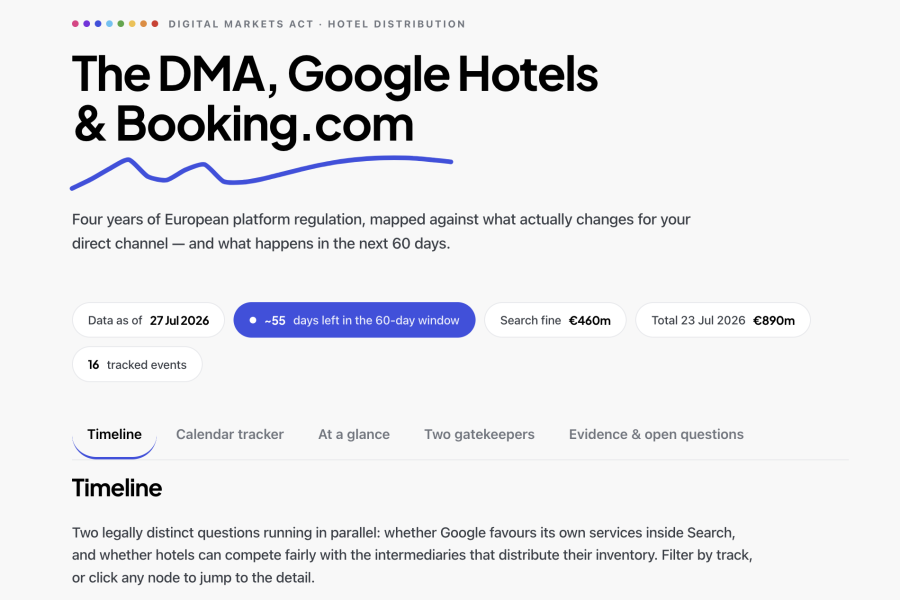

Chronology of Events
The hotel-search test forms part of a longer regulatory process concerning Google, Booking.com and the structure of online travel distribution.
Understanding that history is important because the current debate involves two related but legally distinct questions:
- Whether Google gives its own services preferential treatment within Search.
- Whether hotels can compete fairly with the intermediaries through which much of their inventory is distributed.
– 5th July 2022: the European Parliament adopts the DMA
The European Parliament adopted the Digital Markets Act on 5 July 2022. The Council gave its final approval on 18 July, and the legislation was published in the Official Journal on 12 October.
The DMA entered into force on 1 November 2022 and became applicable on 2 May 2023. Its objective is to make markets involving designated core platform services fairer and more contestable.
– 6th September 2023: Alphabet is designated as a gatekeeper
The European Commission designated Alphabet as a gatekeeper for several core platform services, including Google Search, Google Maps, Google Shopping, Google Play, Chrome, Android, YouTube and its online advertising services.
The designation gave Alphabet six months to bring each designated service into compliance with the relevant DMA obligations.
– 25th September 2023: the Commission blocks Booking’s acquisition of Etraveli
Following an in-depth merger investigation, the Commission prohibited Booking Holdings’ proposed acquisition of Etraveli Group.
The Commission concluded that the transaction would have strengthened Booking’s dominant position in the European Economic Area’s hotel online-travel-agency market.
This was a merger-control decision, not a DMA case. It is nevertheless relevant because it demonstrates that Booking’s market power in European hotel distribution was already attracting regulatory scrutiny before its DMA designation.
– 7th March 2024: Google’s compliance deadline takes effect
Alphabet’s six-month implementation period ended on 7 March 2024. From that date, it was required to demonstrate effective compliance with the DMA obligations applying to its designated core platform services.
Google introduced several changes to its European search results, including dedicated formats intended to increase the visibility of comparison services.
Google subsequently argued that these changes benefited large aggregators and comparison platforms while reducing traffic to airlines, hotel operators and other direct suppliers. These figures and conclusions came from Google and should be treated as the company’s account of the effects.
– 25th March 2024: the Commission opens proceedings against Alphabet
The Commission opened formal non-compliance proceedings to assess whether Alphabet continued to favour its own vertical-search services—including Google Shopping and Google Hotels—over similar competing services.
The investigation focused on whether third-party services were receiving fair and non-discriminatory treatment relative to Alphabet’s own services, as required by Article 6(5).
– 13th May 2024: Booking.com is designated as a gatekeeper
The Commission designated Booking Holdings as a DMA gatekeeper in relation to its Booking.com online-intermediation service.
Booking.com is currently the only OTA designated as a gatekeeper under the DMA. Expedia and other large travel intermediaries have not received the same designation.
This distinction matters. Booking’s designation applies to the specified Booking.com service; it should not be interpreted as a legal determination covering every activity of the wider corporate group.
– 30th July 2024: Spain fines Booking.com €413.24 million
Spain’s National Markets and Competition Commission fined Booking.com €413.24 million for abusing its dominant position in relation to hotels and restricting competition from other OTAs.
This was a Spanish competition-law case and was separate from the European Commission’s DMA enforcement.
– 19th September 2024: the Court of Justice rules on Booking.com’s parity clauses
The Court of Justice of the European Union concluded that Booking.com’s wide and narrow price-parity clauses could not, in principle, be classified as restrictions necessary for the operation of the platform.
The judgment did not itself determine every parity clause to be unlawful in every context. It did, however, reject the argument that such clauses were inherently necessary to protect Booking.com’s business model and strengthened the ability of national courts and competition authorities to scrutinise them.
– 14th November 2024: Booking.com’s DMA obligations become enforceable
Booking.com’s six-month compliance period ended on 14 November 2024.
Among other requirements, the Commission explained that hotels must be free to offer better prices and conditions through their own websites or other channels. Booking.com must not introduce measures with equivalent effects, such as penalising or delisting hotels because they offer better conditions elsewhere.
Hotels and other business users must also receive continuous access to relevant data generated through their use of Booking.com and be able to transfer that data to alternative platforms.
The Commission began monitoring Booking.com’s implementation through its compliance report, stakeholder workshops and information-gathering powers.
HOTREC subsequently argued that Booking.com remained non-compliant and asked the Commission to open formal proceedings. This remains HOTREC’s position; it should not be presented as a Commission finding.
November and December 2024: Google tests removing hotel features
Google tested removing the hotel map and other rich hotel-search features for users in Germany, Belgium and Estonia. The experiment replaced those features with a more conventional list of links.
Google subsequently reported that hotels lost more than 10% of their traffic during the test, that traffic to intermediary sites remained broadly flat and that user satisfaction declined. Google ended the experiment.
These findings were published by Google without an independently disclosed dataset or external audit. They are relevant evidence of the company’s position but should not be treated as a neutral measurement of the complete market effect.
Google’s November 2024 proposal also referred to expanded and similarly formatted units through which users could choose between comparison services and direct suppliers. This provides important context for the interface observed in July 2026.
– 19th March 2025: the Commission issues preliminary findings
The Commission informed Alphabet of its preliminary view that Google Search was treating Alphabet’s own services more favourably than competing third-party services.
The findings included Google’s treatment of shopping, hotel, transport and other specialist results. They represented a preliminary assessment rather than the final decision.
– 23rd July 2026: the Commission confirms Google’s non-compliance
The Commission concluded that Alphabet had failed to comply with Article 6(5) by giving preferential treatment to its own services—including shopping, hotel, transport and sports results—over third-party services in Google Search.
It imposed a €460 million fine for the Search infringement and required Google to bring the non-compliance to an end within 60 days.
The Commission issued a separate €430 million fine concerning restrictions within Google Play, bringing the total announced that day to €890 million. The hotel-search analysis concerns the €460 million Search decision.
What Article 6(5) means for this analysis
Article 6(5) requires a gatekeeper not to treat its own services and products more favourably in ranking—and related indexing and crawling—than similar services or products offered by third parties. The conditions applied must be transparent, fair and non-discriminatory.
Its immediate legal purpose is therefore to prevent Google from favouring its own services over comparable third-party services.
It does not automatically determine:
- Whether an official hotel website must appear before an OTA.
- What share of visibility direct suppliers should receive.
- Where a particular module must appear.
- Whether a consumer should encounter a hotel or an intermediary first.
- How visibility should be divided among different categories of third parties.
These are precisely the questions now emerging from implementation.
HOTREC’s demand for meaningful direct-supplier visibility is consistent with the DMA’s broader objectives of fairness and contestability. It should nevertheless be presented as a policy and market-design position—not as an outcome already expressly guaranteed by Article 6(5).
The history therefore matters because the remedy must address Google’s self-preferencing without ignoring the concentration already present in hotel distribution. A solution that reduces Google’s preferential treatment but significantly increases hotels’ dependence on another powerful intermediary may satisfy part of the legal problem while leaving the wider competition problem unresolved.